
Clustering is performed using add_clusters.

Usage
cluster_plot(
  data,
  cols,
  newcol = NULL,
  k = NULL,
  method = NULL,
  type = "lines",
  reorder = TRUE,
  labels = TRUE,
  clean = TRUE,
  ...
)
Arguments
- data
A tibble.
- cols
A tidy selection of item columns or a single column with cluster values as a factor or logical. If the column already contains a cluster result from add_clusters, it is used, and other parameters are ignored. If no cluster result exists, it is calculated with add_clusters.
- newcol
Name of the new cluster column as a character vector. Set to NULL (default) to automatically build a name from the common column prefix, prefixed with "cls_".
- k
Number of clusters to calculate. Set to NULL to automatically determine an optimal cluster number. For kmeans, outputs a scree plot based on within-sums of squares for up to 10 clusters. In this case, the number of clusters is automatically chosed based on the elbow criterion. For pam, outputs a silhoette plot for up to 10 clusters. In this case, the number of clusters is automatically chosen based on the maximum average silhouette.
- method
The method as a character value, one of
kmeansorpam. See add_clusters for further details.- type
The plot type, one of
"lines"or"heatmap".- reorder
Reorder items to minimize line crossings, Either
TRUEto automatically select a method ("olo"if seriation is installed, otherwise"min"), or one of the character values"max","min","spread","gw", or"olo". Defaults toFALSEwhich disables reordering.- labels
If TRUE (default) extracts labels from the attributes, see codebook.
- clean
Prepare data by data_clean.
- ...
Placeholder to allow calling the method with unused parameters from plot_metrics.
Examples
library(volker)
data <- volker::chatgpt
cluster_plot(data, starts_with("cg_adoption"), k = 2)
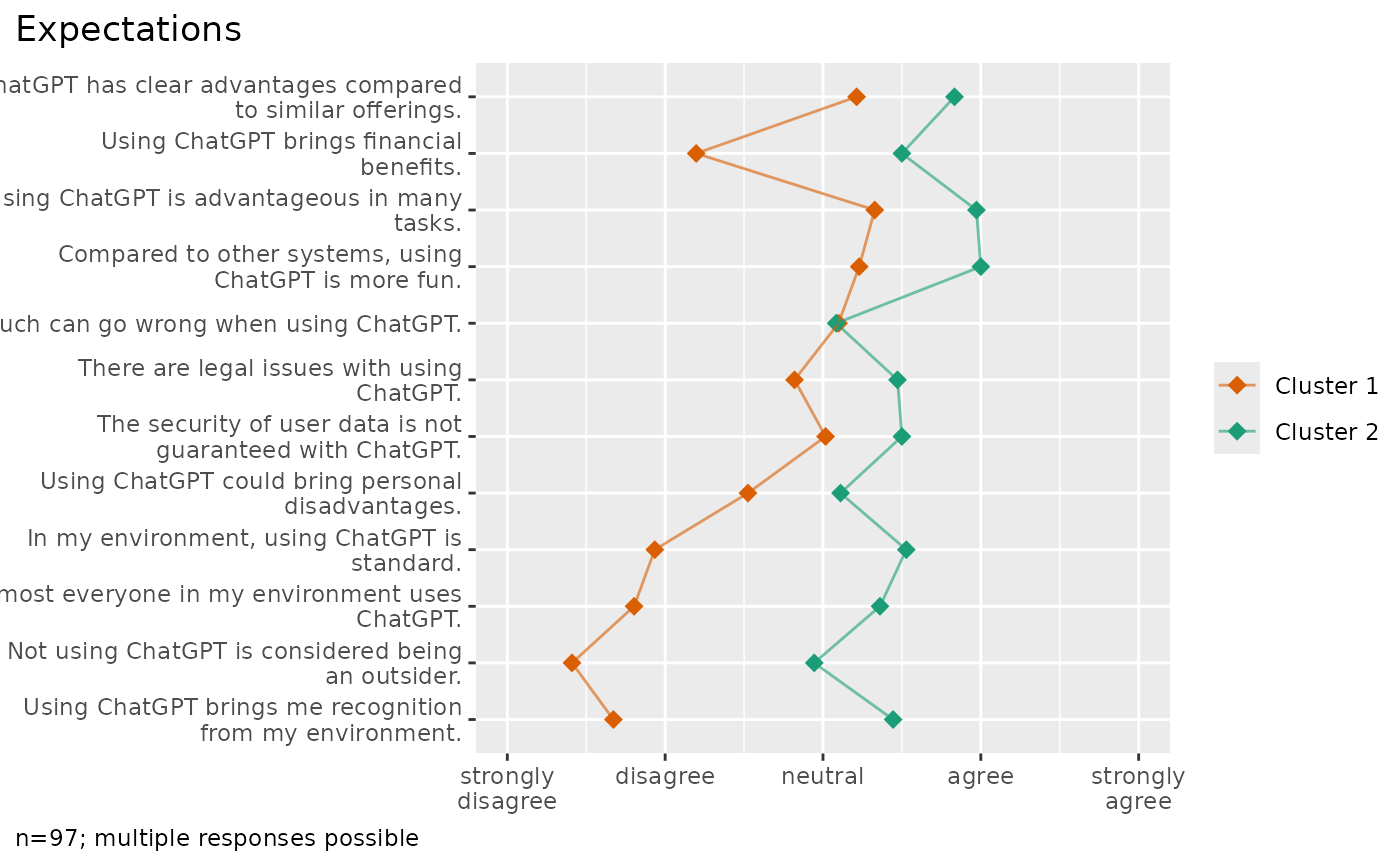 #> In the plot, 4 missing case(s) omitted.